

Handloom vs Hand Tufted Rugs: A Buyer's Comparison
A handloom rug is woven thread by thread on a loom, so its surface is part of its structure. A hand tufted rug is made by punching yarn through a stretched cloth, which frees it to carry pattern, curves and carved relief.
In short
- A handloom rug is woven on a hand-operated loom, so the rug and its texture are made in the same action, with no glued backing.
- A hand tufted rug is made by pushing yarn through a backing cloth with a hand-held tufting gun, then sealing the back and covering it with a second cloth.
- Rugberry weaves plain textures such as the Grain and Plush rugs on the handloom, and tufts patterned and carved designs such as Bergamo and Fluid.
- Neither construction is better for every room: handloom suits quiet texture and reversible use of the floor, hand tufted suits pattern and shaped detail.
What does handloom mean for a rug?
A handloom rug is woven on a loom worked by hand and foot, with weft yarn passed across the warp row by row. Many buyers already know the word from handloom textiles and cotton dhurries, and the principle is the same.


Because the weave is the structure, a handloom rug has no latex layer and no separate backing. Turn one over and you see the weave again, a little plainer than the face.
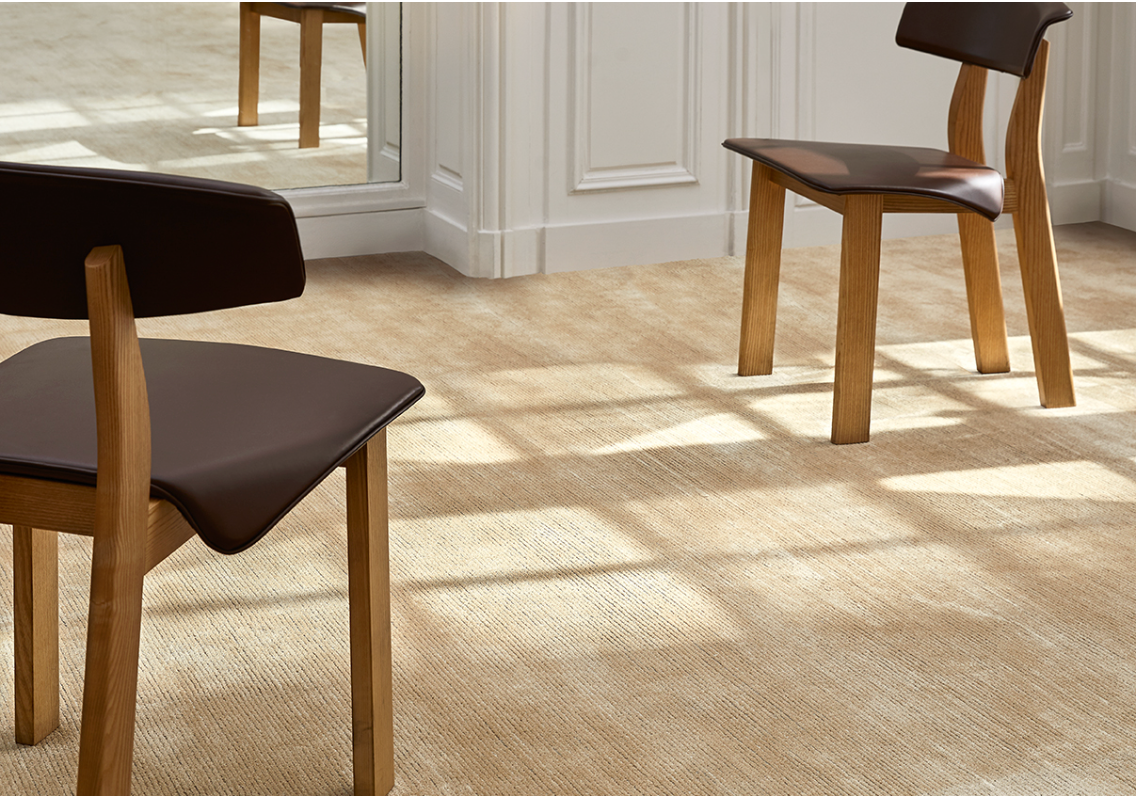
The Grain Wool Rug in flax is handloom woven in New Zealand wool with a low, closely worked surface. The Plush Wool Rug in sand is also handloom, but woven with a deep, quiet pile.
How is a hand tufted rug made?
A hand tufted rug is made on a vertical frame with a cloth stretched across it. The design is drawn on the cloth, and a maker follows the lines with a hand-held tufting gun that loops yarn through.


The loops are then sheared into a cut pile, the back is coated with latex to lock the tufts, and a second cloth is fixed over it. Finally the surface is trimmed, and on some designs channels are carved by hand to raise or lower parts of the pattern.
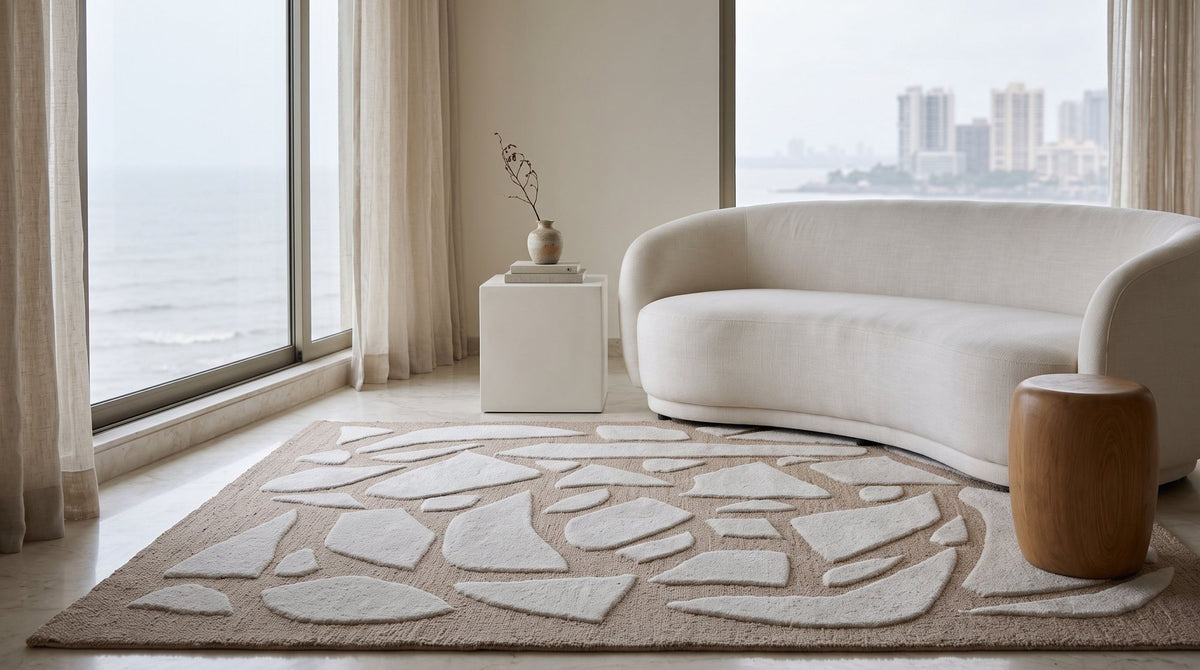
The Bergamo Rug and the Fluid Wool Rug are both hand tufted in New Zealand wool, with a dense pile that holds its shape.
Why does Rugberry weave plain textures on the loom?
A loom is at its best when the beauty lies in the yarn and the weave rather than in a drawn pattern. On a plain rug, every row of weft becomes the design, and small changes in the yarn give the surface its depth.

That is why Rugberry keeps its quiet, single-colour textures on the handloom. Grain shows the weave underfoot, and Plush hides it under a deep pile, but both rely on the yarn and the hand rhythm of the weaver.
Grain starts from AED 3,300 and Plush from AED 3,400 in 5x8 ft / 150x240 cm.
Why are pattern and carving hand tufted?
Tufting lets a maker draw freely. A curve, an irregular shape or a hard edge between two colours is simply a line the tufting gun follows, and a loom would struggle to produce the same shapes.


Fluid runs in slow continuous curves, and Bergamo is drawn with a soft geometry of ivory shapes on camel. Both would be slow and costly to weave on a loom, yet they suit tufting naturally.
On a loom the yarn is the design. With a tufting gun, the drawing is.
Tufting also allows carving, where the pile is cut at two depths to give relief. That sculpted effect is something a flat handloom weave does not offer.
How do handloom and hand tufted rugs compare in daily use?
They differ most in the back, the weight and how they age. The table gives a fair comparison for a living room rug in New Zealand wool.

| Point | Handloom | Hand tufted |
|---|---|---|
| Back | Woven, no glue | Latex sealed, covered with cloth |
| Design freedom | Plain, striped, textured | Any drawn pattern, curves, carving |
| Feel | From flat to deep, depending on weave | Dense, even cut pile |
| Rolling and moving | Rolls easily, flexible | Stiffer, heavier to roll |
| Damp floors | Breathes through the weave | Backing should be kept dry |
For a home that moves often or has a damp ground floor, choose a handloom rug because it is lighter and has no glued back to protect. For a living room that needs a pattern or a shaped edge, choose hand tufted because a loom cannot draw the same lines.
How can you tell them apart in person?
Turn over a corner. A handloom rug shows the weave on the back, with warp threads running the length. A hand tufted rug shows a plain fabric cloth, often with a stitched or bound edge.


Next, bend the rug. Handloom flexes like heavy fabric, while hand tufted feels stiffer and springs back more firmly. Both are made by hand, but in different ways, and neither is a lesser rug.
Frequently asked questions
Is a handloom rug the same as a dhurrie?
A dhurrie is one kind of handloom rug, usually a flat cotton or wool weave with no pile. A handloom rug can also have a deep pile, as the Plush Wool Rug from Rugberry does.
Does a hand tufted rug have glue in it?
Yes. A hand tufted rug has a latex coating on the back that holds the tufts in place, covered by a second cloth. This is normal for the construction and is why the back should be kept dry.
Which is more durable, handloom or hand tufted?
Durability depends more on the wool, the density and the care than on the method alone. A dense hand tufted New Zealand wool rug and a closely woven handloom rug can both give many years of use in a living room.
Weave for texture, tuft for drawing. See handloom in the Grain and Plush collections, and hand tufted designs across the full range. Material first.


