

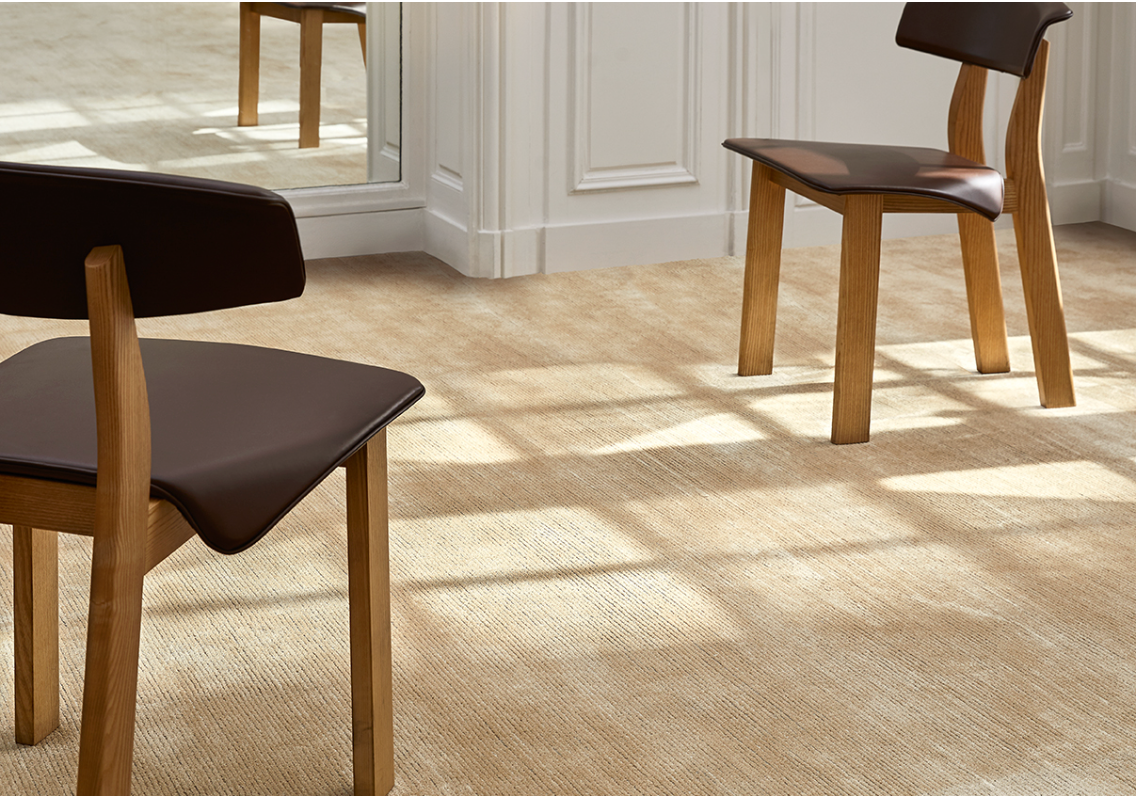

Mohair in Rugs: Lustre, Resilience and Rarity
Mohair is the hair of the Angora goat, a smooth, lustrous fibre that shines almost like silk and springs back like good wool. It is rare in rugs because the fibre is scarce and costly, so it suits a statement room and a custom order rather than everyday stock.
In short
- Mohair is the fleece of the Angora goat, not the Angora rabbit, and it is known for a high natural lustre and strong resilience.
- Mohair shines because its fibre surface has flatter, smoother scales than wool, so it reflects more light.
- A mohair rug combines a sheen close to silk with a spring close to wool, which makes it one of the most durable lustrous fibres for a floor.
- Rugberry makes mohair in two constructions, the handwoven Mohair Relic and the hand knotted Mohair Sillage, both made entirely to your measure.
What is mohair?
Mohair is the fleece of the Angora goat, sheared from the animal and spun into yarn. The name causes confusion: angora wool comes from the Angora rabbit, a different fibre altogether.


The fibre is long, smooth and fairly thick, and young goats give a finer grade known as kid mohair. The Mohair collection shows how it looks in a rug.
Why does mohair shine?
Mohair shines because the scales along each fibre lie flat and smooth, so light bounces off evenly instead of scattering. Wool's scales stand up more, which gives wool its matt glow.


The same smooth surface makes mohair take dye with unusual clarity. Colours look bright and clean, and pale shades have a soft glow rather than a flat tone. The trade calls this quality lustre.
How does mohair compare with wool and silk?
Mohair sits between wool and silk: nearly as bright as silk, nearly as resilient as wool. The table shows the trade-offs for a rug.

| Wool | Mohair | Silk | |
|---|---|---|---|
| Sheen | Soft, matt | High, lustrous | High, deep |
| Spring after pressure | Good | Very good | Low |
| Feel | Soft with body | Smooth, slightly crisp | Cool and smooth |
| Availability | Plentiful | Scarce | Moderate |
| Cost of fibre | Moderate | High | High |
For a statement living room that also sees guests, choose mohair over silk if you want shine that recovers from feet, because mohair springs back where silk crushes.
Mohair shines like silk and springs back like wool. That pairing is rare in any fibre.
Where does a mohair rug belong in a villa or apartment?
A mohair rug belongs in a formal living room, a library or a large bedroom, a room built around one striking piece. Its lustre rewards good light, such as a tall window softened by sheers, or warm lamps in the evening.

Mohair is warm, so in the Gulf it belongs in air conditioned rooms rather than on a shaded terrace. It also shows its best in a plain or tonal design, where the sheen is the pattern.
How do you order a mohair rug from Rugberry?
Order it to measure. Rugberry makes mohair in two forms: Mohair Relic, handwoven, light and open with a long lustre lying along the weave, about 12 mm thick; and Mohair Sillage, hand knotted, close and lustrous and firmer underfoot, about 20 mm thick. Both are made entirely to your measure, in any size and colour.
- Order a 1x1 ft (30x30 cm) swatch, AED 200, and look at the sheen in your own light, morning and evening.
- Share the room size in feet or centimetres, a daylight photo and how the room is used, and choose woven or knotted.
- Ask whether mohair suits that use, and ask for the fibre and construction to be written on the specification before anything is made.
Because the fibre is scarce and every piece is made to measure, ask for a quote for your exact size before you commit. The Rugberry sales line is +971 55 303 9091.
Which ready sized Rugberry rugs give lustre and depth?
If you want a stock size rather than a piece made to measure, three Rugberry rugs answer parts of what mohair offers. Each is a different fibre with its own character.


- Luma Silk Rug in greige: handloom silk with a sheen that changes as the light moves, from AED 3,100 in 5x8 ft (150x240 cm).
- Cashmere Blend Rug in natural: handloom wool and cashmere, fine, dense and very soft, from AED 4,900.
- Plush Wool Rug in ivory: handloom New Zealand wool with a deep, quiet pile, from AED 3,400.
How do you care for a mohair rug?
Care for a mohair rug gently and regularly, much as you would a fine wool. Vacuum on suction only, without a rotating brush, because a brush can rough up the smooth fibre and dull its sheen.
Mohair resists soiling well, but it is still an animal fibre that dislikes harsh, alkaline cleaners. Blot spills with a dry white cloth, use cool water sparingly, and leave deep cleaning to a rug cleaner who handles fine fibres.
Turn the rug every few months. A lustrous fibre shows the direction of wear more than a matt one, and rotation keeps the sheen even across the room. Rugberry can advise on care for any piece before it is made.
Frequently asked questions
Is mohair the same as angora?
No. Mohair comes from the Angora goat, while angora wool comes from the Angora rabbit. Mohair is the stronger and more lustrous of the two and the one used in rugs.
Is a mohair rug durable?
Yes, mohair is resilient and recovers well from pressure, which makes it one of the more durable lustrous fibres. Its sheen also tends to hide light soiling better than a matt fibre.
Does Rugberry make mohair rugs?
Yes. Rugberry makes mohair rugs to your measure, handwoven as Mohair Relic or hand knotted as Mohair Sillage. A 1x1 ft (30x30 cm) swatch is AED 200.
Rare fibre asks for a clear brief and an honest look at cost. Material first.


